 Pooka
Pooka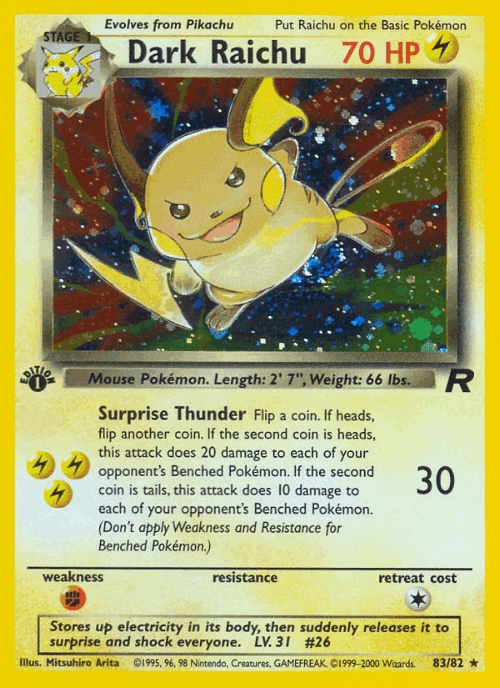
The Card That Shouldn't Exist
When Team Rocket released on April 24, 2000, collectors knew exactly what to expect: an 82-card set featuring villainous "Dark" Pokémon with sinister attacks and shadowy artwork. Players opened booster packs hunting for Dark Charizard, Dark Blastoise, and other corrupted versions of beloved Pokémon. The set checklist was clear, numbered 1 through 82. Everything was accounted for.
Then someone pulled card #83. Dark Raichu (numbered 83/82) appeared in booster packs with no warning, no mention in promotional materials, and no explanation. It was impossible. It shouldn't exist. Yet there it was: a secret hidden in plain sight, numbered outside the set's official count. Dark Raichu became the Pokémon TCG's first secret rare, launching a collecting phenomenon that would define the franchise for the next quarter-century.
Dark Raichu (83/82)
The original secret rare that started it all, numbered impossibly outside Team Rocket's 82-card set.
The Discovery and Community Reaction
The first Dark Raichu pulls sparked immediate confusion and excitement on early Pokémon TCG forums and message boards. Collectors debated whether it was a printing error, a misprint, or an intentional Easter egg. Some theorized Wizards of the Coast made a counting mistake and accidentally numbered 83 cards in an 82-card set. The mystery added to the card's mystique.
Within days, Wizards of the Coast confirmed Dark Raichu was completely intentional: a deliberate secret bonus card inserted at lower pull rates than regular holos. It wasn't an error; it was Wizards' first experiment with hidden chase cards beyond the official set count. The TCG community went wild. Suddenly, completing Team Rocket wasn't just about collecting cards 1-82. You needed #83 too. The chase was on.
Dark Raichu's pull rate was significantly lower than standard rare holos, making it one of the hardest cards to obtain from Team Rocket. Its secret status combined with genuine scarcity drove demand through the roof. This wasn't just a cool card; it was a status symbol proving you were a serious collector who'd gone beyond the ordinary set completion. Wizards had successfully created artificial excitement through intentional scarcity and surprise.
Why Dark Raichu? The Anime Connection
Dark Raichu wasn't chosen randomly for secret rare status: it had a specific pop culture connection that resonated with Pokémon fans. In the anime episode "Electric Shock Showdown" (Episode 14), Ash battles Lt. Surge's Raichu at Vermilion City Gym. Lt. Surge mocks Ash for not evolving his Pikachu, claiming Raichu is superior in every way. His Raichu is portrayed as aggressive, overconfident, and somewhat villainous compared to Ash's loyal Pikachu.
While not explicitly a "Dark" Pokémon in the game sense, Lt. Surge's Raichu embodied the antagonistic spirit perfect for Team Rocket's theme. Wizards of the Coast recognized that Raichu had this darker, meaner reputation in the anime, making it an ideal candidate for the set's hidden bonus card. It was thematically appropriate and commercially smart: Raichu is Pikachu's evolution, guaranteeing collector interest.
The card's artwork by Mitsuhiro Arita captures this aggressive energy perfectly. Dark Raichu crouches with a menacing expression, electricity crackling around its body, ready to unleash devastating attacks. The flavor text reinforces the theme: "Stores up electricity in its body, then suddenly releases it to surprise and shock everyone." Both the anime connection and the artwork made Dark Raichu the perfect secret rare.
The Card: Surprise Thunder
Dark Raichu is a Stage 1 Lightning-type Pokémon with 70 HP, standard for evolved Pokémon in the Base era. Its single attack, "Surprise Thunder," costs three Lightning energy and deals 30 damage to the Active Pokémon. The real power comes from its coin-flip mechanic: flip a coin; if heads, flip another coin. If the second flip is heads, deal 20 damage to each of your opponent's Benched Pokémon. If tails, deal 10 damage to each Benched Pokémon. Weakness and Resistance don't apply to the Benched damage.
This double coin-flip mechanic made Dark Raichu notoriously unreliable but potentially devastating. Successfully hitting double heads meant spreading 20 damage across your opponent's entire Bench while dealing 30 to the Active, a total of 50+ damage in a single attack during an era when most Pokémon had 40-80 HP. The variance was extreme: you could whiff both flips or sweep an entire Bench.
With a retreat cost of just one Colorless energy and a Fighting weakness (×2), Dark Raichu was splashable in Lightning decks but vulnerable to the popular Hitmonchan. Competitively, it saw fringe play: the coin flips were too unreliable for serious tournament use, but casual players loved the chaos. Its value came from rarity and novelty, not competitive viability. Dark Raichu was a collector's card first, a game piece second.
Market Value and Collectibility
Dark Raichu's secret rare status immediately made it one of Team Rocket's most valuable cards despite its mediocre playability. In 2000-2001, raw copies sold for $10-20 (premium pricing when most holos were $3-8). While exact pull rates were never officially disclosed, collectors reported Dark Raichu appeared roughly once per booster box or less, making it significantly rarer than standard holos though more accessible than today's hyper-rare chase cards.
Today, Dark Raichu remains iconic among vintage collectors. Raw near-mint Unlimited copies typically sell for $30-80, while PSA 9 graded copies command $100-200. PSA 10 specimens (extremely rare due to the card's age and print quality issues from the Base era) can reach $500-1,200+. Note that Team Rocket was only released as Unlimited edition in English; any cards claiming "1st Edition" are counterfeits or errors.
What makes Dark Raichu special isn't just its monetary value but its historical significance. It's the card that invented secret rares in Pokémon TCG. Every modern rainbow rare, gold card, and alternate art secret traces its lineage back to this single Lightning-type Stage 1 from Team Rocket. Collectors who own Dark Raichu own a piece of TCG history: the moment everything changed.
The Secret Rare Evolution
Dark Raichu established the secret rare template, but the concept evolved significantly over the following decades. Legendary Collection (2002) introduced reverse holo secret rares. EX Team Rocket Returns (2004) continued the tradition with Dark Pokémon secret variants. The early secret rares were sparse: one or two per set at most, maintaining genuine rarity and excitement.
The modern era exploded the concept. Black & White introduced Full Art cards as secret rares. XY added Mega Evolution secret rares. Sun & Moon brought Rainbow Rares and Gold cards, with sets containing 10+ secret rares. Sword & Shield continued this trend with Alternate Art cards, Gold cards, and Rainbow variants filling slots beyond the base set count. Some sets now have 30+ cards numbered above the official set size.
This evolution reflects changing collector priorities. Dark Raichu was a bonus surprise: a Easter egg for dedicated fans. Modern secret rares are expected, marketed, and chase cards driving booster box sales. The magic of "discovering" something unexpected has been replaced by calculated hunting for specific high-value pulls. Dark Raichu represents a simpler time when secret rares truly were secret, not just premium cards with higher numbers.
Other Influential Early Secret Rares
Dark Raichu paved the way for future secret rares that built on its foundation. Birthday Pikachu from the Wizards Black Star Promos deserves mention: while not numbered outside a set, it was distributed exclusively through the Pokémon Center Birthday program, making it extraordinarily rare and valuable. Shining Pokémon from Neo Destiny (2002) featured unique holographic patterns and powerful mechanics, though they were numbered within the official set count rather than beyond it like modern secret rares.
EX Team Rocket Returns (2004) featured Dark Pokémon ex cards as secret rares, directly continuing Dark Raichu's villainous theme. Legendary Collection's reverse holo secret rares of classic cards like Charizard created a subset of chase variants. Each iteration refined the concept, but none captured the pure surprise of Dark Raichu's original reveal: the moment players realized cards could exist beyond the official count.
The Evolution of Secret Rares
Key cards that built on Dark Raichu's foundation, showing how secret rares evolved over 25 years.
Collecting Dark Raichu Today
For collectors pursuing Dark Raichu in 2025, several factors affect value and availability. Team Rocket was released as Unlimited edition only in English, so all authentic English copies lack the 1st Edition stamp. Raw near-mint copies typically range from $30-80 depending on condition and market timing. Condition is critical: look for clean borders, minimal edge wear, sharp corners, and good centering. Team Rocket's print quality was inconsistent, with many copies showing slight off-centering or print lines.
Grading significantly impacts value. PSA 9 copies command 2-3x raw prices ($100-200), while PSA 10 examples are genuinely scarce due to print quality issues, reaching $500-1,200+. When purchasing, verify authenticity: Dark Raichu counterfeits exist due to its iconic status. Authentic copies have a distinctive cosmos holo pattern, correct font sizing, and proper card stock thickness. Purchase from reputable sellers with clear photos and return policies.
Beyond dollar value, Dark Raichu represents essential Pokémon TCG history. It completes the Team Rocket master set and belongs in every serious vintage collection, not just for rarity, but for its historical significance as the original secret rare that changed collecting forever.
The Lasting Legacy
Dark Raichu's impact on Pokémon TCG culture cannot be overstated. Before #83/82, set completion was straightforward: collect cards 1 through X, done. Dark Raichu introduced uncertainty, excitement, and extended chase goals. It taught collectors that sets could hide secrets, that the printed count wasn't absolute, and that the hunt never truly ends.
This philosophy permeates modern Pokémon TCG design. Secret rares drive booster box sales, create viral pull videos, and sustain secondary market values long after sets rotate out of competitive play. The entire business model of modern TCG releases depends on chase cards numbered beyond the base set, a direct descendant of Dark Raichu's innovation. What started as a single bonus card became a pillar of TCG economics.
For players who opened Team Rocket packs in 2000, pulling Dark Raichu remains a core memory. That moment of confusion, realization, and excitement when you see "83/82" printed on the card: it was lightning in a bottle. Modern collectors experience similar thrills with alternate arts and rainbow rares, but there's only one first time. Dark Raichu was that first time, and its legacy ensures it will always be remembered as the card that changed everything.
Twenty-five years later, Dark Raichu stands as a monument to a simpler TCG era while remaining eternally relevant. It's not the most expensive card, the rarest pull, or the most competitive Pokémon. But it is the first secret rare: the card that proved Pokémon TCG could surprise us, that sparked the chase for hidden treasures, and that forever altered how we think about set completion. In the history of Pokémon TCG, few cards matter more than the Lightning Mouse that shouldn't have existed: Dark Raichu, card #83 in an 82-card world.
All cards in this guide
| Card | Set | Rarity | Released | |
|---|---|---|---|---|
 | Dark Raichu #83 | Team Rocket | Rare Secret | 2000 |
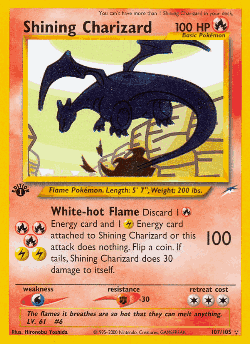 | Shining Charizard #107 | Neo Destiny | Rare Shining | 2002 |
 | Dark Espeon #4 | Neo Destiny | Rare Holo | 2002 |
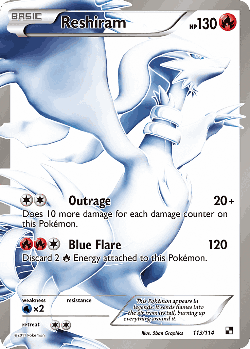 | Reshiram #113 | Black & White | Rare Ultra | 2011 |
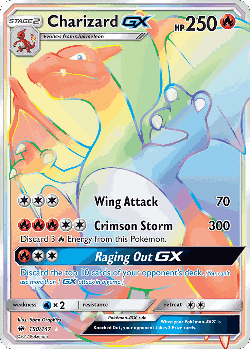 | Charizard-GX #150 | Burning Shadows | Rare Rainbow | 2017 |
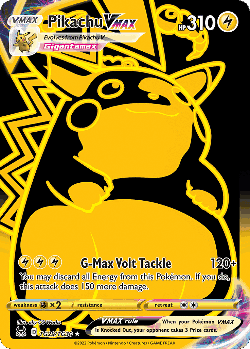 | Pikachu VMAX #29 | Lost Origin Trainer Gallery | Rare Secret | 2022 |