 Pooka
Pooka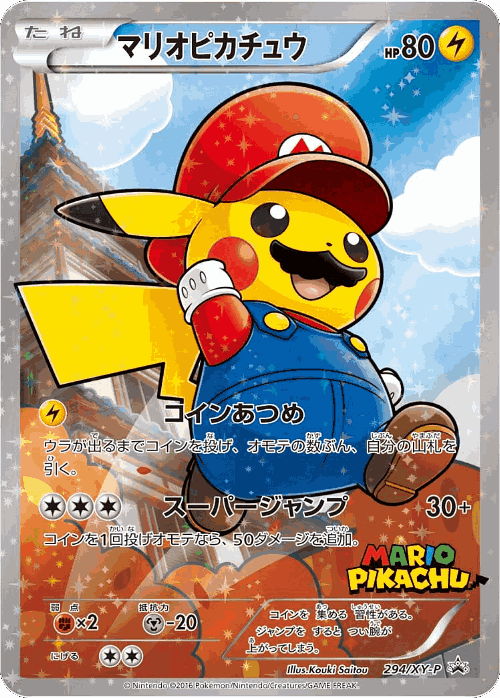
Nintendo's Dream Team
Nintendo has always been protective of its intellectual property, rarely allowing its flagship franchises to cross over. While Pokémon and Mario have coexisted under the Nintendo umbrella since the late 1990s, they've remained largely separate, appearing in Smash Bros. together but never truly collaborating.
That changed in 2013 when Nintendo of Japan released four promotional Pikachu cards numbered XY-P 293-296. These cards featured Pikachu dressed as Mario (red cap and overalls) and Luigi (green cap and overalls), each with two variant artworks. The crossover delighted fans of both franchises and created instant collectible classics that have never been reprinted or released outside Japan, becoming some of the rarest and most valuable Pikachu promos ever made.
How to Get Them: The Japanese Campaign
These cards were distributed exclusively through Pokémon Centers in Japan during a special promotional campaign in 2013. The distribution method was extremely limited, with only select Pokémon Centers in Japan receiving small allocations. The exact distribution mechanism remains somewhat mysterious (some sources suggest lottery systems, others mention purchase requirements), but the result was clear: very few copies entered circulation.
The campaign's limited scope and brief duration created extreme scarcity from day one. Collectors who wanted all four cards faced nearly impossible odds, as each card was distributed separately with no guaranteed method to obtain the complete set. No official English release ever occurred, making these pure Japan-exclusive grails. The combination of Nintendo crossover appeal, Pikachu's popularity, and microscopic print runs ensured these would become some of the most valuable modern promo cards.
Mario Pikachu
Pikachu dressed as Mario with his iconic red cap and overalls, featuring coin-flipping mechanics.
Luigi Pikachu
Pikachu dressed as Luigi with his green cap and overalls, featuring the powerful Super Dash attack.
Game Mechanics: Coins and Jumps
All four cards share the same attack structure but with key differences between Mario and Luigi versions. Both feature "Coin Gather" as their first attack, costing one Lightning energy: "Flip a coin until you get tails. Draw a card for each heads." This perfectly captures the coin-collecting essence of Mario games while providing potentially powerful card draw in the TCG.
The second attack differs between brothers. Mario Pikachu has "Super Jump" for three Colorless energy, dealing 30 damage with a coin flip: heads adds 50 damage for a total of 80. Luigi Pikachu has "Super Dash" for the same cost, dealing a flat 60 damage but inflicting 20 damage to itself. This mirrors Luigi's higher jump and slightly awkward, self-damaging playstyle from the Mario & Luigi RPG series.
Both cards have 80 HP with no weaknesses, resistances, or retreat cost listed on the provided data, though standard Lightning-type Pikachu typically carry Fighting weakness. The coin-flip mechanics on every attack create a fittingly luck-based playstyle reminiscent of Mario Party and other Nintendo board games.
Artwork: Kouki Saitou's Masterpiece
Artist Kouki Saitou illustrated all four cards, creating a cohesive aesthetic across the set. The artwork shows Pikachu perfectly cosplaying as the Mario Bros., complete with detailed fabric textures on the caps and overalls, expressive poses mid-jump, and backgrounds that evoke the Mushroom Kingdom's vibrant colors.
What makes these cards special is the attention to detail: Pikachu's ears poke through the caps, the overalls have the signature buttons and stitching, and the facial expressions capture both Pikachu's charm and Mario/Luigi's determination. The variant artworks (293 vs 294, 295 vs 296) show different action poses (one set shows dynamic jumping, the other shows ready stances), giving collectors visual variety while maintaining thematic consistency.
The color schemes perfectly match each brother: warm reds and golds for Mario (#dcb753 theme), cool greens and yellows for Luigi (#cebf57 theme). These theme colors blend Pikachu's electric yellow with the respective Mario brother's signature palette, creating a harmonious fusion of both franchises.
Collector Value: Japan-Exclusive Premiums
As ultra-rare Japan-exclusive crossover promos from 2013, these cards command astronomical prices on the secondary market. Raw near-mint copies typically sell for $2,000-4,000 USD per card, with complete sets of all four cards commanding $10,000-15,000 or more. PSA 10 graded copies regularly exceed $5,000-8,000 each, with some auction results breaking $10,000 for pristine specimens.
The Mario variants (293-294) tend to be slightly more expensive than Luigi variants (295-296), though all four are extremely valuable. Market availability is sporadic: months can pass between listings for any specific variant. When they do appear for sale, they're typically snapped up quickly by serious collectors willing to pay premium prices. The combination of Nintendo crossover appeal, microscopic print runs, and zero reprints creates relentless upward price pressure.
Unlike speculative modern promos that crash after hype fades, Mario & Luigi Pikachu have appreciated consistently since 2013. Their rarity is genuine: not artificially created by scalpers but by legitimately limited distribution. They represent the absolute pinnacle of Pikachu promo collecting, rivaling or exceeding even the most expensive Illustrator and Trophy cards in desirability. For most collectors, owning even one is a major achievement; owning all four is the stuff of legends.
Competitive Playability
While charming and collectible, Mario & Luigi Pikachu were never competitively viable. The reliance on coin flips for both attacks makes them inconsistent, and 80 HP is too fragile for serious play even by 2013 XY-era standards. "Coin Gather" can theoretically draw many cards, but the odds of flipping multiple heads consecutively are low: statistically, you'll average 1 card per use.
Mario's "Super Jump" requires a coin flip to hit meaningful damage (80 with heads, only 30 otherwise), while Luigi's "Super Dash" deals respectable 60 damage but the 20 self-damage hastens your own knockout. Both require three energy for attacks that don't stack up against competitive Lightning-type attackers from the same era.
These cards were designed as collectibles first, game pieces second. They're legal in Expanded format tournaments but you'll never see them at competitive tables. Their value lies entirely in nostalgia, crossover appeal, and rarity: not strategic utility. That said, they're incredibly fun for casual play and Mario/Nintendo-themed deck builds.
Why This Crossover Matters
The Mario & Luigi Pikachu cards represent something larger than just promotional items: they're evidence of Nintendo's willingness to blend its franchises in unexpected ways. For decades, Nintendo maintained strict brand separation. Mario stayed in platformers and sports games, Pokémon remained in its own universe, Zelda kept to Hyrule. Crossovers were limited to Smash Bros., where the excuse was "they're just toys/trophies."
These cards broke that wall in 2013, creating a moment that felt revolutionary for Nintendo collectors. They acknowledged that both franchises coexist under Nintendo's banner and that fans would delight in seeing them interact. The crossover was purely for promotional/collectible purposes rather than tied to any specific game featuring both franchises, but it opened the door for future collaborations. We've since seen more crossovers: Detective Pikachu, Pokémon Quest, and various crossover events in Pokémon GO.
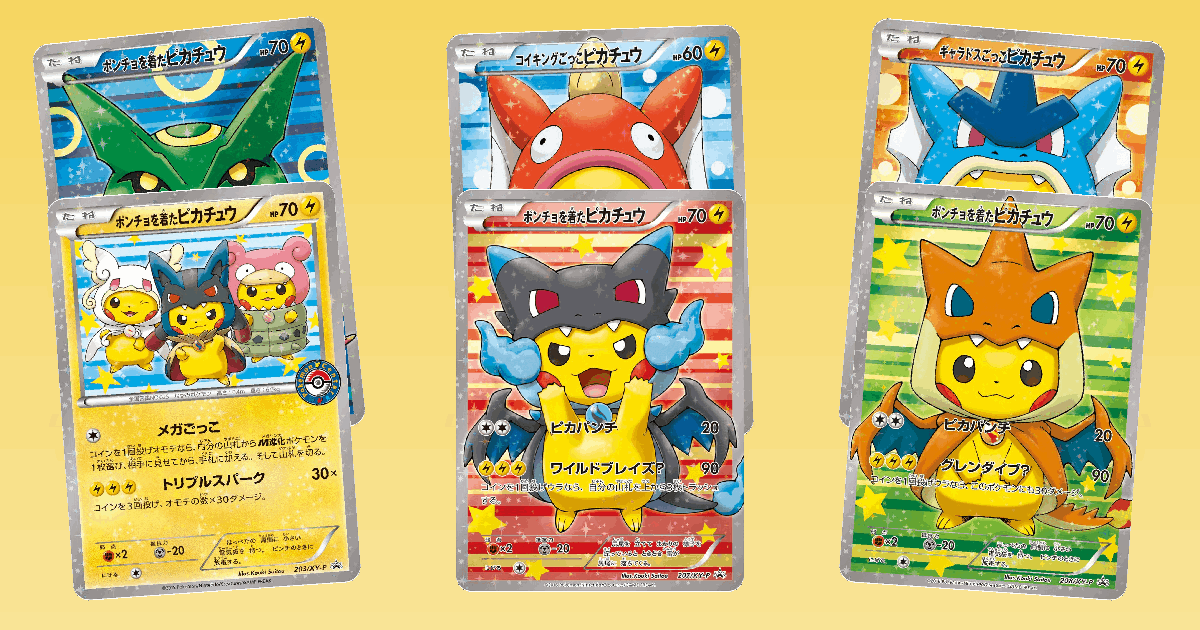
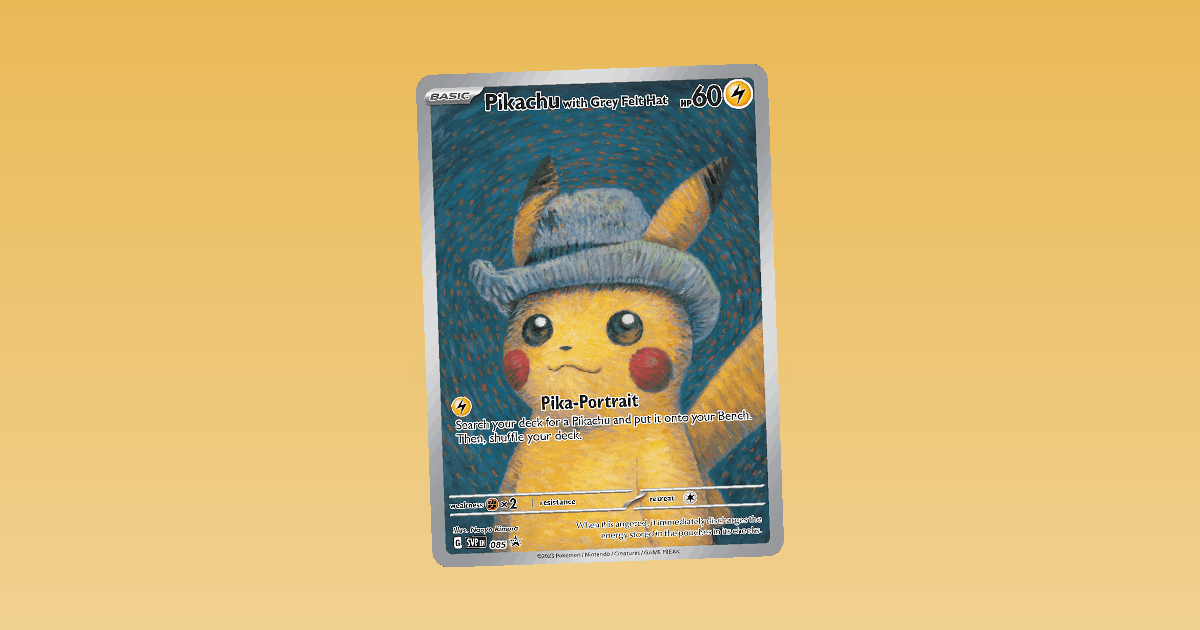
The cards also set a precedent for character costume cards. The Poncho-wearing Pikachu series followed similar logic: Pikachu cosplaying as other Pokémon and characters. Van Gogh Pikachu continued the tradition of Pikachu as cultural ambassador. Mario & Luigi Pikachu proved that Pokémon TCG could celebrate Nintendo's broader identity, not just the Pokémon franchise in isolation.
The Legacy of Crossover Promos
Over a decade after their 2013 release, Mario & Luigi Pikachu remain legendary among collectors who appreciate crossover content. They're consistently ranked among the rarest and most expensive Pikachu promos ever made, appearing in "ultimate grails" discussions alongside Illustrator Pikachu and Trophy Pikachus. Their charm hasn't faded. If anything, the passage of time and Nintendo nostalgia has only increased their mystique and value.
The cards highlight a bittersweet reality: some of the coolest Pokémon TCG content never leaves Japan. Western collectors must navigate import markets, language barriers, and eye-watering prices to obtain cards that remain pure Japan-exclusives. The extreme scarcity means even wealthy collectors struggle to find them for sale at any price. For most, these cards exist only in photos and dreams.
For those lucky enough to own them, these four cards represent peak Nintendo crossover energy, a time when the company experimented with blending its universes, creating something that delighted fans of both franchises. Whether you're a Mario fan, a Pikachu collector, or just someone who appreciates excellent crossover design, the Mario & Luigi Pikachu cards stand as monuments to what happens when Nintendo's creative teams are allowed to play.
All cards in this guide
| Card | Set | Rarity | Released | |
|---|---|---|---|---|
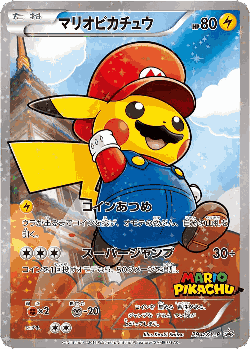 | Mario Pikachu #294 | XY Promos | Promo | 2013 |
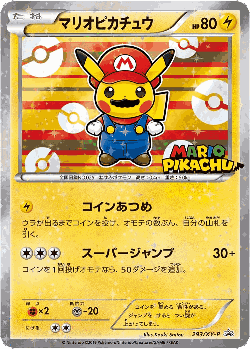 | Mario Pikachu #293 | XY Promos | Promo | 2013 |
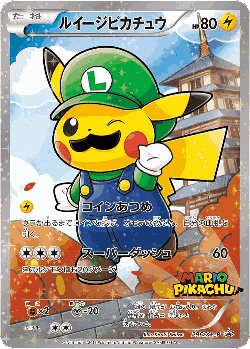 | Luigi Pikachu #296 | XY Promos | Promo | 2013 |
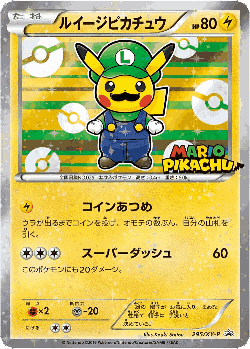 | Luigi Pikachu #295 | XY Promos | Promo | 2013 |